How Trump is using the ‘Madman Theory’ to try to change the world (and it’s working) – BBC
DrWeb
·
BBC
How Trump is using the ‘Madman Theory’ to try to change the world (and it’s working) 1 day ago
By Allan Little, Senior correspondent
Asked last month whether he was planning to join Israel in attacking Iran, US President Donald Trump said “I may do it. I may not do it. Nobody knows what I’m going to do”.
He let the world believe he had agreed a two-week pause to allow Iran to resume negotiations. And then he bombed anyway.
A pattern is emerging: The most predictable thing about Trump is his unpredictability. He changes his mind. He contradicts himself. He is inconsistent.
“[Trump] has put together a highly centralised policy-making operation, arguably the most centralised, at least in the area of foreign policy, since Richard Nixon,” says Peter Trubowitz, professor of international relations at the London School of Economics.
“And that makes policy decisions more dependent on Trump’s character, his preferences, his temperament.”
Getty Images. Donald Trump speaks to reporters before boarding the Marine One presidential helicopter and departing the White House on 24 June 2025 in Washington DC. Getty Images
Trump has learned to put his unpredictability to political use, making it a key strategic and political asset.
Trump has put this to political use; he has made his own unpredictability a key strategic and political asset. He has elevated unpredictability to the status of a doctrine. And now the personality trait he brought to the White House is driving foreign and security policy.
It is changing the shape of the world.
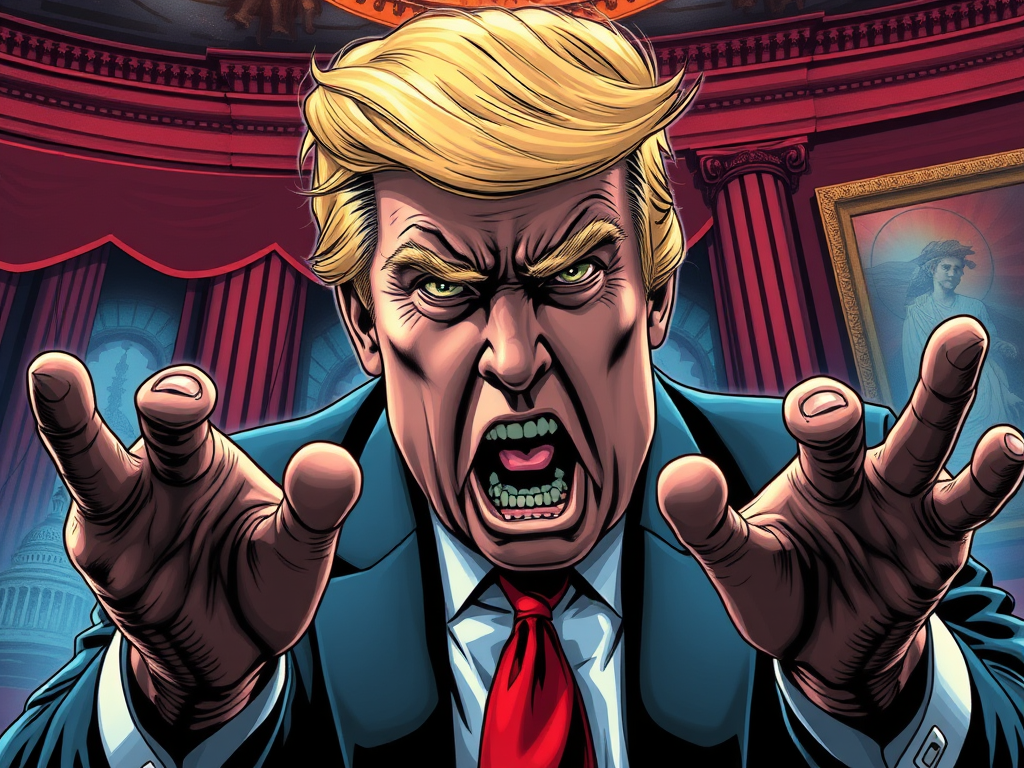
Political scientists call this the Madman Theory, in which a world leader seeks to persuade his adversary that he is temperamentally capable of anything, to extract concessions. Used successfully it can be a form of coercion and Trump believes it is paying dividends, getting the US’s allies where he wants them.
But is it an approach that can work against enemies? And could its flaw be that rather than being a sleight of hand designed to fool adversaries, it is in fact based on well established and clearly documented character traits, with the effect that his behaviour becomes easier to predict?
Attacks, insults and embraces
Trump began his second presidency by embracing Russian President Vladimir Putin and attacking America’s allies. He insulted Canada by saying it should become the 51st state of the US.
He said he was prepared to consider using military force to annex Greenland, an autonomous territory of America’s ally Denmark. And he said the US should retake ownership and control of the Panama Canal.
Article 5 of the Nato charter commits each member to come to the defence of all others. Trump threw America’s commitment to that into doubt. “I think Article 5 is on life support” declared Ben Wallace, Britain’s former defence secretary.
Conservative Attorney General Dominic Grieve said: “For now the trans-Atlantic alliance is over.”
A series of leaked text messages revealed the culture of contempt in Trump’s White House for European allies. “I fully share your loathing of European freeloaders,” US Defence Secretary Pete Hegseth told his colleagues, adding “PATHETIC”.



Leave Your Comments