
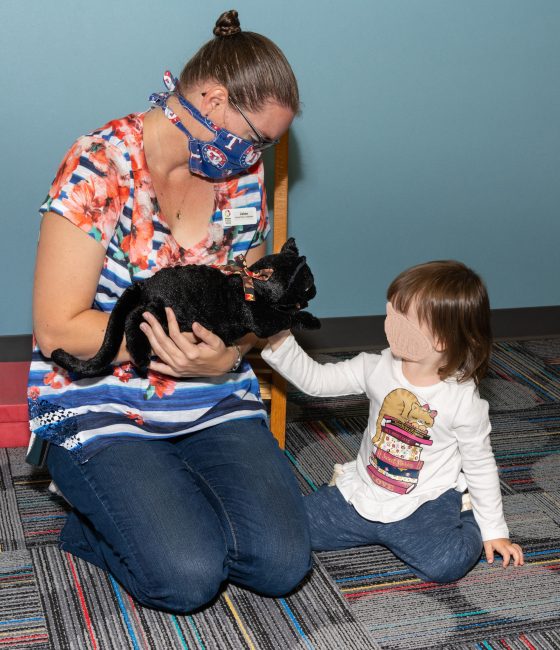
Do you ever use a host puppet in storytime? I added this practice to my repertoire when I joined my current library. Previously, storytimes were just me and the kids. Adding a host puppet felt uncomfortable and unnatural. Nearly ten years later, I can’t imagine storytimes without my trusty cat, Shadow. Still, host puppets intimidate many new storytime trainees. Here are some tips from my experience for adding one to your storytime.
What is a host puppet and why do we have them?
Host puppets appear at the beginning of storytime to welcome families and set the stage. These dedicated puppets only appear here, not in other programs. Each storytime presenter has an individual puppet, and they create a different level of interaction between presenters and children. Often, children are more comfortable interacting with our host puppets than with us. Some days, they’re more excited to see the puppets than the presenters. Further, puppets are a proven, actionable early learning strategy. They help build language, communication, and social skills. The unique puppet personalities also add imagination and a sense of wonder to storytime. In addition, seeing a host puppet each week adds familiarity and routines. It’s easy for caregivers to continue learning at home, too, with puppets or stuffed animals of their own.
Who has a host puppet?
All presenters for our Toddler Times, Preschool Storytimes, and Family Storytimes have host puppets. Storytime trainees choose and develop their puppets as part of training. They do not earn presenter status until they are confident with their puppet. In my library, we currently have twelve different puppets that appear during storytime. In addition, host puppets visit outreach storytimes. Shadow, a black cat, serves as my host puppet.
When do we use them?

Host puppets appear at the beginning of storytime after we cover our expectations and sing the welcome song. The puppet introduces the letter of the week and the corresponding theme. Then, puppets return at the end of storytime to say goodbye to participants if they choose.
Introductions vary from presenter to presenter. Some host puppets are sleepy and need the audience to wake them up, while others reveal themselves with clues. Some presenters ask if the audience remembers their friend and let participants respond. Further, each puppet has a unique personality, so their audience interactions differ. Some sing a song, others tell jokes, and a few converse with the presenter. Others are shy and may whisper to the presenter without interacting directly with the audience. These are at the presenter’s discretion and are not a requirement. Each presenter chooses what feels natural to their presentation style and puppet personality.
I use clues to introduce Shadow: “I have a special friend who likes to join me at storytime. My friend has pointy black ears [showing just the tips of her ears behind the storytime easel]. She has a long black tail [showing her tail curled around the easel]. Sometimes, my friend says, “Meow!” Do you know what animal she is?” Once revealed as a cat, Shadow sings a song to kick off storytime before bringing us the letter of the week.
Where do we get our puppets?
We purchase our host puppets from Folkmanis, but any puppet works! When researching puppets, pay attention to the feel, fit, construction, and ways you can manipulate them. If possible, visit a store and try the puppet in person. If not, spend quality time with it once purchased. Can you create the desired expressions? Will the puppet last over many uses and interactions?
Some presenters purchase their puppets so they can travel throughout their careers. Others select from building resources and leave their puppets behind if they leave. In either case, have a future-proof plan. Puppets may wear out, or vendors may discontinue options. My first puppet’s head came unsewn from the body, and the vendor no longer offered that model. My host puppet “grew up” to a larger form. I also purchased backup puppets to prevent a future recurrence or unexpected retirement.
How can you use a host puppet in your storytime?

Using a host puppet is as personal as your presentation style. Consider these things as you develop your host puppet’s personality and role.
- Know your puppet’s personality. Your puppet is another character in storytime with a personality and quirks, which will come across in voices, gestures, and interactions.
- Practice with your puppet. Get comfortable with how it moves and how you’ll make it real. Try out any planned songs or movements. Use a mirror or ask your coworkers to provide feedback.
- Have an introduction. How will you introduce your puppet? Will this vary depending on your audience or consistency in attendance?
- Make sure your puppet, not you, engages with the audience. Any time your puppet talks, sings, or communicates, the focus should be on its performance. Angle your puppet for visibility and make eye contact with the puppet during its routine. This demonstrates that you fully engage with the puppet and encourages families to interact similarly.
- Treat your puppet as alive all the time. Whenever your puppet might be visible (like going between your desk and the storytime room), make sure you maintain the illusion. Keep your puppet’s movements and carrying realistic, or make sure your puppet remains out of sight (in a bag or a box, for example).
What’s next?
Want to learn more about puppets in storytime? Check out Jbrary’s New to Storytime: Using Puppets for great tips and examples. For another twist to puppets, check out this post on puppet shows at storytime. Do you have a host puppet? Share your tips and tricks in the comments, too.
This post addresses ALSC Core Competency #3: Programming Skills. All photos courtesy of Plano Public Library and provided by Jaime Eastman, ALSC member.

Jaime Eastman is a senior Public Services Librarian and Early Learning Coordinator at the Harrington Library, one of the Plano (Texas) Public Library locations. She’s currently serving as a member of the ALSC Board of Directors. Jaime is also working on at least two ambitious cross-stitch projects, dreaming of future travel plans, and reading far too many books. As a child, she wanted to grow up to be an author. Writing for the blog and publishing with Children and Libraries feel like a good start, and she regrets nothing about her adult decision to be a librarian doing storytimes who didn’t have to grow up too much.
The post Host Puppets: Bringing Storytime Magic to Life appeared first on ALSC Blog.
Do you ever use a host puppet in storytime? I added this practice to my repertoire when I joined my current library. Previously, storytimes were just me and the kids. Adding a host puppet felt uncomfortable and unnatural. Nearly ten years later, I can’t imagine storytimes without my trusty cat, Shadow. Still, host puppets intimidate many new storytime trainees. Here are some tips from my experience for adding one to your storytime. What is a host puppet and why do we have them? Host puppets appear at the beginning of storytime to welcome families and set the stage. These dedicated puppets only appear here, not in other programs. Each storytime presenter has an individual puppet, and they create a different level of interaction between presenters and children. Often, children are more comfortable interacting with our host puppets than with us. Some days, they’re more excited to see the puppets than…
The post Host Puppets: Bringing Storytime Magic to Life appeared first on ALSC Blog. Read More
ALSC Blog

Leave Your Comments