

Politics 9 min read
Roberts and Kagan prepare for another showdown on executive power
By Joan Biskupic, CNN Chief Supreme Court Analyst, Dec 5, 2025 See all topics

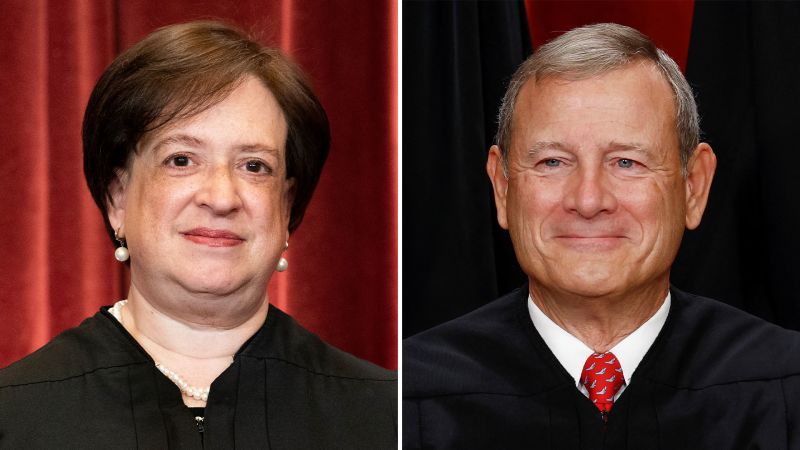
Chief Justice John Roberts and Justice Elena Kagan are well matched, rhetorically forceful opposites. And they have been clashing for more than a decade over an increasingly relevant question of presidential power: How easy should it be for the president to fire the heads of independent agencies?
That issue, to be aired at the Supreme Court on Monday, has grown more salient as President Donald Trump has attempted to remove multiple officials, including at the Federal Trade Commission, National Labor Relations Board and Federal Reserve.
Their first faceoff occurred in 2009 before Kagan had even joined the court, as she was serving as US solicitor general, standing in the well of the courtroom, with Roberts looking down from the center chair. They tangled over a 1935 precedent that protects agency independence and that now hangs in the balance, Humphrey’s Executor v. United States.
Since his days as a young lawyer in the Ronald Reagan administration, Roberts has argued for vast executive power, including the authority to fire individuals who lead administrative agencies. “Without such power,” Roberts wrote in the 2009 dispute over a corporate auditing board, “the President could not be held fully accountable for discharging his own responsibilities; the buck would stop somewhere else.”
Kagan, in contrast, believes the constitutional separation of powers allows Congress to establish and safeguard certain areas of administrative independence. And she has relied on Supreme Court rulings, including the 1935 milestone, that have allowed Congress to prevent the president from removing independent administrators without sufficient grounds.
Monday’s case was brought by former Federal Trade Commissioner Rebecca Slaughter, who received a March 18 email from Trump saying her “continued service on the FTC is inconsistent with my Administration’s priorities.” (Under the law governing the FTC, commissioners can be removed only for “inefficiency, neglect of duty, or malfeasance in office.”)
The court’s ruling will extend far beyond Slaughter and the FTC and have vast consequences for specialized regulation in an array of financial, environmental and public safety spheres.
In an early phase of Slaughter’s lawsuit, in September, the Roberts majority reversed a lower court order that would have allowed Slaughter to stay in her post. The move was consistent with Roberts’ opinions that have steadily eroded the reach of Humphrey’s Executor v. United States and signaled he considers it a dead letter.
Related article Supreme Court flicks at First Amendment concerns with state’s subpoena of faith-based pregnancy centers
“The majority may be raring to take that action,” Kagan observed as she dissented from that September action. “But until the deed is done, Humphrey’s controls, and prevents the majority from giving the President the unlimited removal power Congress denied him.”
More broadly, the eventual ruling could build on other decisions providing Trump more power as he carries out his second term agenda. Last year, Roberts and his fellow conservatives granted Trump substantial immunity from prosecution as it expanded the concept of a president’s “conclusive and preclusive” authority. Then, earlier this year, the court freed the administration from lower-court nationwide orders against his various policy initiatives.
These decisions have dissolved constraints on the president, and if the court were to reverse the 1935 case, the president would be further unburdened by congressional legislation barring him from removing agency officials without sufficient grounds.
Vanderbilt University political science professor John Dearborn, who has studied the Reagan era development of a “unitary executive theory” and Roberts’ writings, told CNN, “He’s had these kinds of ideas for a long time, that the only way that agencies are accountable is if the president has the power to fire people.”
‘I didn’t say anything bad about Humphrey’s Executor’
Before joining the bench, Roberts and Kagan were first-rate oral advocates with their own, respective, steady and tenacious styles. Roberts served as a deputy US solicitor general during the George H.W. Bush administrations and then appeared frequently at the court in private practice. He argued a total 39 cases before the high court.
Kagan, who hadn’t previously argued a case at the high court, was named US solicitor general in 2009 by President Barack Obama. She went on to argue six cases, including the presidential-removal controversy, before Obama nominated her to the bench in 2010 to succeed retiring Justice John Paul Stevens.
Continue/Read Original Article Here: Roberts and Kagan prepare for another showdown on executive power | CNN Politics
Discover more from DrWeb's Domain
Subscribe to get the latest posts sent to your email.