
American democracy on the brink a year after Trump’s election, experts say
Scale and speed of president’s moves have stunned observers of authoritarian regimes – is the US in democratic peril?

By Lauren Gambino, Wed 21 Jan 2026 07.00 EST
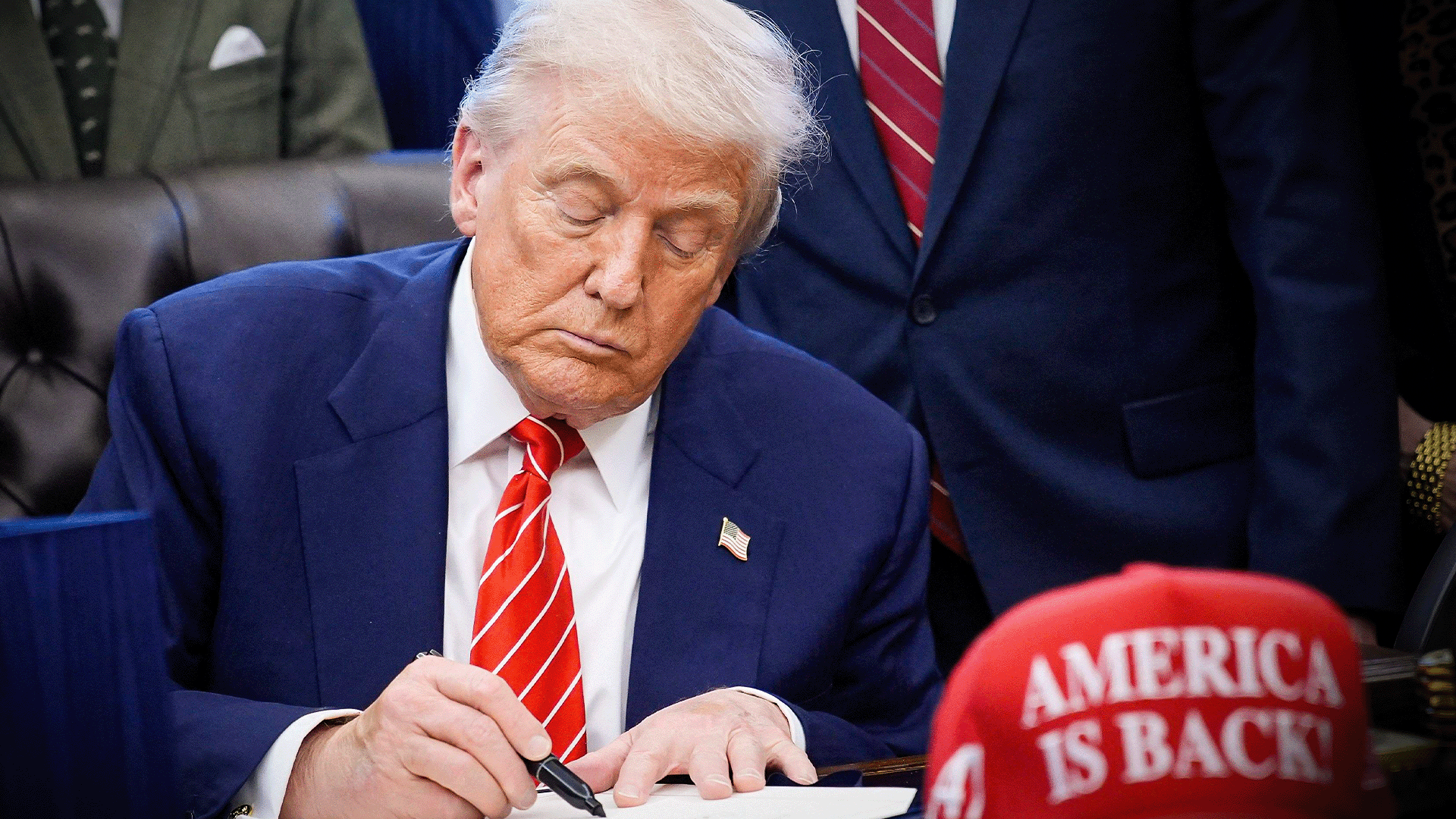
Three hundred and sixty-five days after Donald Trump swore his oath of office and completed an extraordinary return to power, many historians, scholars and experts say his presidency has pushed American democracy to the brink – or beyond it.
In the first year of Trump’s second term, the democratically elected US president has moved with startling speed to consolidate authority: dismantling federal agencies, purging the civil service, firing independent watchdogs, sidelining Congress, challenging judicial rulings, deploying federal force in blue cities, stifling dissent, persecuting political enemies, targeting immigrants, scapegoating marginalized groups, ordering the capture of a foreign leader, leveraging the presidency for profit, trampling academic freedom and escalating attacks on the news media.
The scale and velocity of what he has been able to accomplish in just a year have stunned even longtime observers of authoritarian regimes, pushing the debate among academics and Americans from whether the world’s oldest continuous democracy is backsliding to whether it can still faithfully claim that distinction.
“In 2025, the United States ceased to be a full democracy in the way that Canada, Germany or even Argentina are democracies,” Steven Levitsky and Daniel Ziblatt, the prominent Harvard political scientists and authors of How Democracies Die, and the University of Toronto professor Lucan Way, wrote in Foreign Affairs last month. They argued that the US under Trump had “descended into competitive authoritarianism”, a system in which elections are held but the ruling party abuses power to stifle dissent and tilt the playing field in its favor.
There is no universally accepted definition of democracy. Some argue the US is a “flawed” or “illiberal” democracy, or a democracy facing substantial “autocratization” – a process that began long before Trump came to power a decade ago but which his presidency has rapidly accelerated. Still, others believe the concerns are overblown, or reflect an intense partisan dislike of the current president.
Since Trump’s first term, scholars have warned that it can happen here. But many now say this moment is different – not only because Trump’s approach is more methodical and his desire for vengeance more pronounced, but because he now faces far fewer internal constraints.
The president’s Republican critics have mostly been driven from public office and those who remain say they fear retaliation for speaking out. Trump has repeatedly circumvented the GOP-controlled Congress, on spending, tariffs and war powers. And the US’s European allies are scrambling to respond to Trump’s threats to acquire Greenland, by force if necessary. In an interview with the New York Times earlier this month, Trump declared that the only constraint on his presidential power was “my own morality”.
Quantitive assessments of the country’s democratic health point are bleak.
Ratings of US democracy by scholars – and Americans overall – dropped “significantly” after Trump took office last year, according to data from Bright Line Watch, a non-partisan democracy-monitoring initiative that surveys political scientists and the public on potential threats and erosions. In its September survey, experts rated US democracy 54 on a 100-point scale, placing the country closer to illiberal or hybrid regimes than to the full democracies of G7 peers such as Canada or the United Kingdom.
An assessment by the Century Foundation’s new democracy indexing project found that the US had recorded a staggering 28% “collapse” in democratic health over the past year – from 79/100 in 2024 to 57/100 in 2025, the kind of sudden decline more typically associated with coup or other major shock.
Nate Schenkkan, the report’s lead author and a former research director at Freedom House, hoped to help Americans distinguish between the “push-pull” of partisan politics and the “authoritarian behavior” of the current administration.
“When a major change happens in a political system, it’s very unevenly distributed,” Schenkkan said. “Certain people will feel it first. Certain communities will feel it harder and faster. And it is really important to recognize that just because it hasn’t come to you doesn’t mean that it won’t.”
The sense of alarm is especially acute among those who witnessed democratic backsliding elsewhere. Last year, a network of former intelligence and national security professionals applied the same analytical methods they once used to assess the fragility of democracies abroad to the United States. In October, they published an intelligence-style report, concluding with “moderate to high confidence” that the country was “on a trajectory” toward authoritarian rule.
Continue/Read Original Article: https://www.theguardian.com/us-news/2026/jan/21/trump-american-democracy
Original article: View source
Discover more from DrWeb's Domain
Subscribe to get the latest posts sent to your email.