
News From Us
Read more: Signature Republican Bill Heads to Final Votes – GovTrack.usSource Links: Signature Republican Bill Heads to Final Votes – GovTrack.us
Legislative Preview
Signature Republican Bill Heads to Final Votes
June 30, 2025 · by Amy West and Joshua Tauberer
Signature Republican Bill Heads to Final Votes
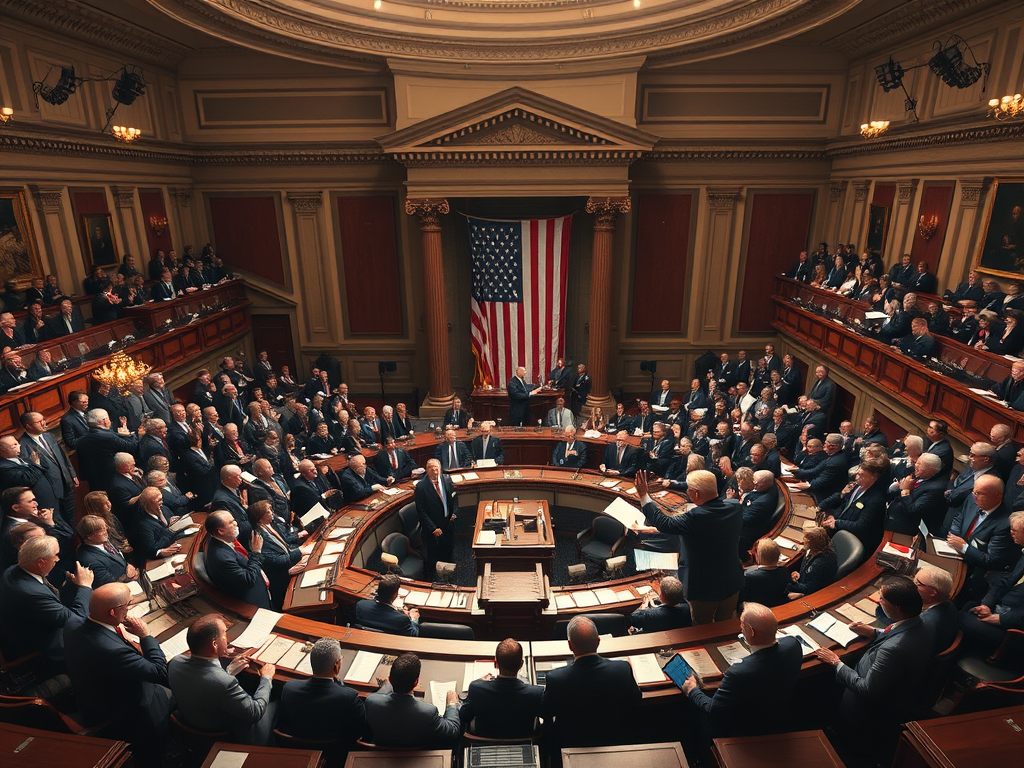
The House is out this week, at least that’s what the calendar says. The Senate currently tentatively also has itself as out this week, but Senate Majority Leader Thune says he still intends to get the Republican’s signature bill, H.R. 1: One Big Beautiful Bill Act, through the Senate and passed back to the House with a goal of it getting to the President for signature by July 4. That most likely means everybody will be coming in this week.
What’s in the bill? We’re not entirely sure. At 940 pages, it’s hard to know, and significant changes may be made right up until the Senate votes. The latest text would increase the statutory limit on the national debt by $5 trillion (about 14%) and the Congressional Budget Office projects it would add $3.3 trillion to the national debt over 10 years, mostly from re-enacting President Trump’s 2017 tax cuts which are expiring, as well as increased spending on the military ($150 billion) and border security and immigration detention ($90 billion). The biggest savings are from reducing higher education loans (saving $270 billion) and food assistance (saving $186 billion).
The “Reconciliation” Bill
H.R. 1 is the so-called “reconciliation bill” which under special rules means it can be passed by a simple majority in the Senate, rather than the usual 3/5ths needed to end a filibuster.
To meet the rules for the simple majority, the bill must not contain provisions that are extraneous to budgetary issues. That’s informally called the Byrd Rule. The Congressional Research Service goes into more detail: the Senate Parliamentarian reviews the bill text and provides advisory opinions on which provisions would be extraneous. (That’s what was happening last week, more on that below.) Then, either the majority party can cut or revise those provisions. (Or they could change the rules, which we discussed previously.)
Here’s a guide to where we are in the long reconciliation process:
Pass budget resolutions in each chamber which set general caps on spending – done
Pass a bill in the House that specifies exactly how the money gets spent – done
Senate Parliamentarian reviews the bill and any proposed changes by senators for compliance with Byrd Rule – we are here
Pass the bill in the Senate – not done
If the Senate makes changes, which is expected, or even rewrites the entire bill, it goes to back to the House for another vote (or, less likely, a conference committee) – not done
Send to the President for signing – not done
H.R. 1 passed the House in May. Now in the Senate, just as in the House, there are conflicting policy preferences among the Republicans and they need all the votes they can get to pass the bill. For example, the bill provides $25 billion dollars to stabilize rural hospitals. But Senators like Collins and Tillis wanted $100 billion. Also, the Senate version increases the debt ceiling more than the House version which will displease Sen. Paul who is already unhappy with including debt limit provisions at all.
There are also conflicting policy preferences between House and Senate legislators, so the Senate has to be mindful of whether the House will accept the Senate’s changes. And, senators are carefully crafting provisions to get past the Byrd Rule.
So What Didn’t Comply with the Byrd Rule?
A lot of things did not comply with the Byrd Rule. Some of the more controversial provisions from the House version that remain in the Senate version and which will be subject to a 60 vote majority include:
The ban on care for transgender people
Deregulation of gun silencers
Limits on Medicaid and Medicare for immigrants
Below is a list of provisions the Parliamentarian advised don’t meet Byrd Rule requirements, grouped by the committee with jurisdiction over the provision:. (These links are coming from Democratic senators because they have the best lists of what’s been cut.)
Homeland Security and Governmental Affairs
Energy and Natural Resources
Health, Education, Labor and Pensions
Finance
Commerce, Science and Transportation and Judiciary
What’s Next?
The Senate held its first procedural vote in the evening of Saturday June 28, on revised version of the House’s bill. The vote, called a “motion to proceed” passed 51-49, but only after hours of mid-vote negotiations with hold out senators including Senators Murkowski (AK), Johnson (WI) and Lee (UT). Next up is a reading of the entire 940 page bill and then votes on amendments. Currently, a final vote is expected possibly Monday, June 30. However, at least one senator, Sen. Collins (ME), who voted to proceed has yet to commit to voting to pass the bill itself.
At the same time there will continue to be intense negotiations over other aspects of the bill because, Byrd rules notwithstanding, there are other areas of disagreement among Republicans. So, expect lots of votes and also more changes to the text before it’s passed.
President Trump’s goal to have the bill by July 4 is arbitrary, but if Congress doesn’t pass this or another bill to raise or eliminate the debt ceiling by mid-summer, the federal government may catastrophically run out of money.
Let us know what you think about these updates by tooting us on Mastodon or sending us an email.
Discover more from DrWeb's Domain
Subscribe to get the latest posts sent to your email.