A young Ernest Hemingway on what would prove his most fruitful trip to Pamplona, in July 1925. Illustration by Nigel Buchanan (detail)A 1939 photograph of the novelist, right, that hangs at Café Iruña. Charlotte Yonga.
Go Behind the Scenes of the Running of the Bulls
July/August 2025
An offbeat journey to the legendary Spanish festival 100 years after the life-changing trip that inspired Ernest Hemingway to write “The Sun Also Rises”
Key takeaways: What is the running of the bulls One of Europe’s most popular gatherings, the running of the bulls takes place over nine days in Pamplona, Spain. Each morning, a small herd of bulls runs through the village streets, chasing thousands of participants clad in all white with red scarves. The festival catapulted to worldwide attention after the publication of Ernest Hemingway’s The Sun Also Rises, which chronicles the Spanish tradition.
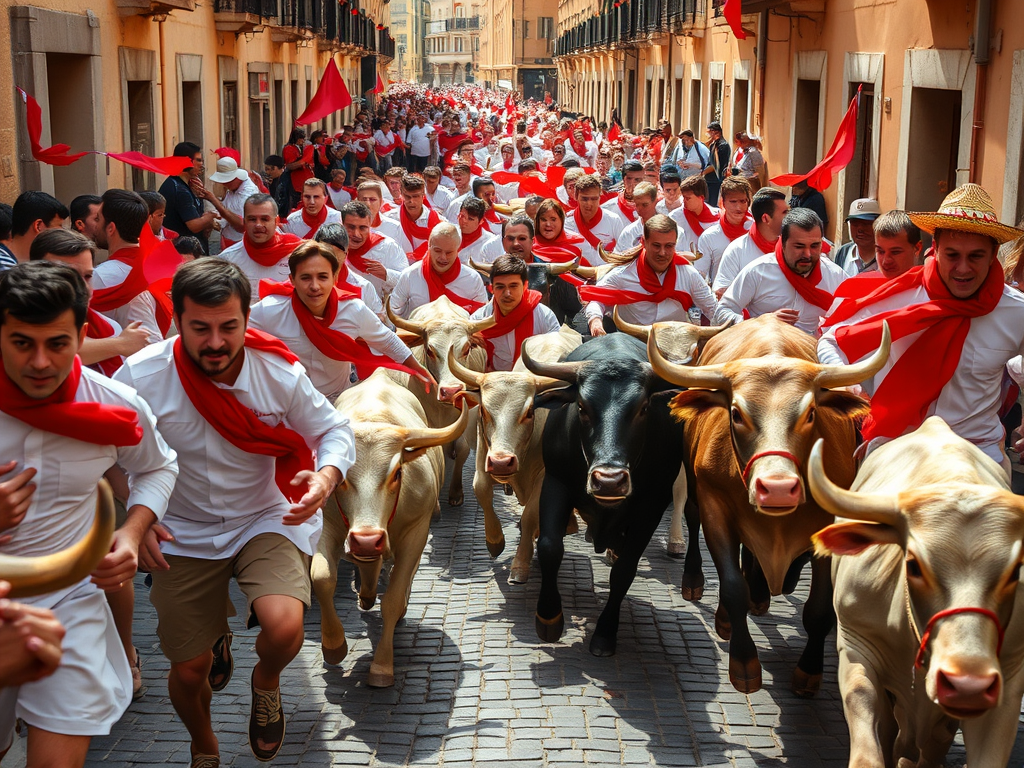
In the annals of European travel, few summer holidays have been so artistically productive as the trip taken by the aspiring 25-year-old writer Ernest Hemingway in July 1925 to Pamplona, the elegant Spanish provincial town in the foothills of the Pyrenees. “Hem,” as he was called by his friends, traveled from Paris with his first wife, Hadley Richardson, to attend the annual Festival of San Fermín, whose most famous element is the running of the bulls, where mostly young men in white outfits with red bandanas and sashes race a dozen enormous bulls and steers through narrow cobbled streets, with the occasional bloody goring or stomping along the way.
It was an immersive event with an electric mood, as he had found during his first visit with Richardson two years earlier, when he had jotted notes: “Fifes, drums, reed pipes … red neckerchiefs, circling, lifting, floating dance, all day all night, leather wine bottles over shoulder, flat Basque caps or wide straw hats, faces like smoked buckskin, flat backs, flat hips, dancing, dancing …” He was dazzled by the spectacular daily bullfights, as well as the fireworks, bands on the plaza, packed cafés, cheap wine and faces in the crowd: the “faces of Velázquez’s drinkers, Goya and Greco faces.”
On their third and most dramatic visit to the festival, in 1925, Hemingway and Richardson were joined by five Anglo-American expat friends, all heavy-drinking, rootless bohemians like himself. The intense, alcohol-fueled, sexually charged interaction inspired Hemingway to write his first and arguably finest novel, The Sun Also Rises, using thinly veiled characters and incidents from the sojourn. The milestone of Modernist literature was published in New York the following year, immediately putting the young author on the path to international celebrity as the voice of the postwar “Lost Generation”—and, incidentally, changing Pamplona forever.
For centuries, the nine-day event had been just one of dozens of annual Spanish festivals, many of which also involve encierros, or bull runs. But its profile skyrocketed as The Sun Also Rises became a smash best seller and was later made into a 1957 hit film starring Tyrone Power, Errol Flynn and Ava Gardner. Largely thanks to the novel’s success—and Hemingway’s follow-up meditations Death in the Afternoon from 1932 and the posthumous The Dangerous Summer—San Fermín became established as the ultimate Spanish celebration. Today it is one of Europe’s most popular gatherings, luring more than a million visitors every year, with a round-the-clock party atmosphere that puts Mardi Gras in New Orleans to shame. It has become so popular that as many as 3,500 runners clog the bull-running course, making trampling the biggest danger.
And yet the American connection to Pamplona remains unshakable. Many American runners and spectators have attended for decades, along with niche groups of aficionados such as the New York City Club Taurino (Bullfighting Club), who relish the traditions and pageantry of San Fermín but don’t train as matadors themselves. “People who go to Pamplona inspired by Hemingway are surprised at first,” says Jennifer May Reiland, a young Brooklyn-based artist and club member. “It can seem like spring break in Florida. But the town’s traditional life still goes on behind the scenes. It’s still wildly romantic.”